
Restoration: Making Space for What Has Been Lost
When we think about helping children who have experienced trauma, we often focus on what needs to be changed.
We talk about behaviors.
We talk about coping skills.
We talk about regulation.
We talk about what a child needs to learn or how a child needs to respond differently.
But sometimes, before we can ask a child to learn something new, we have to make space for what has been lost.
That is where restoration comes in.
Trauma can take things from children that we don't always see.
It can interrupt a child's ability to trust.
It can change the way they understand relationships.
It can make the world feel unpredictable.
It can take away a sense of safety, confidence, connection, or simply the ability to be a kid.
For children who have experienced foster care, adoption, family disruption, abuse, neglect, or other difficult experiences, relationships can be especially complicated.
A child may desperately want connection while also being afraid of it.
They may want to trust an adult while their experiences have taught them that adults aren't always safe.
They may test boundaries, push people away, or struggle to accept care—not because they don't want connection, but because connection has not always felt safe.
We believe restoration often begins in very simple places.
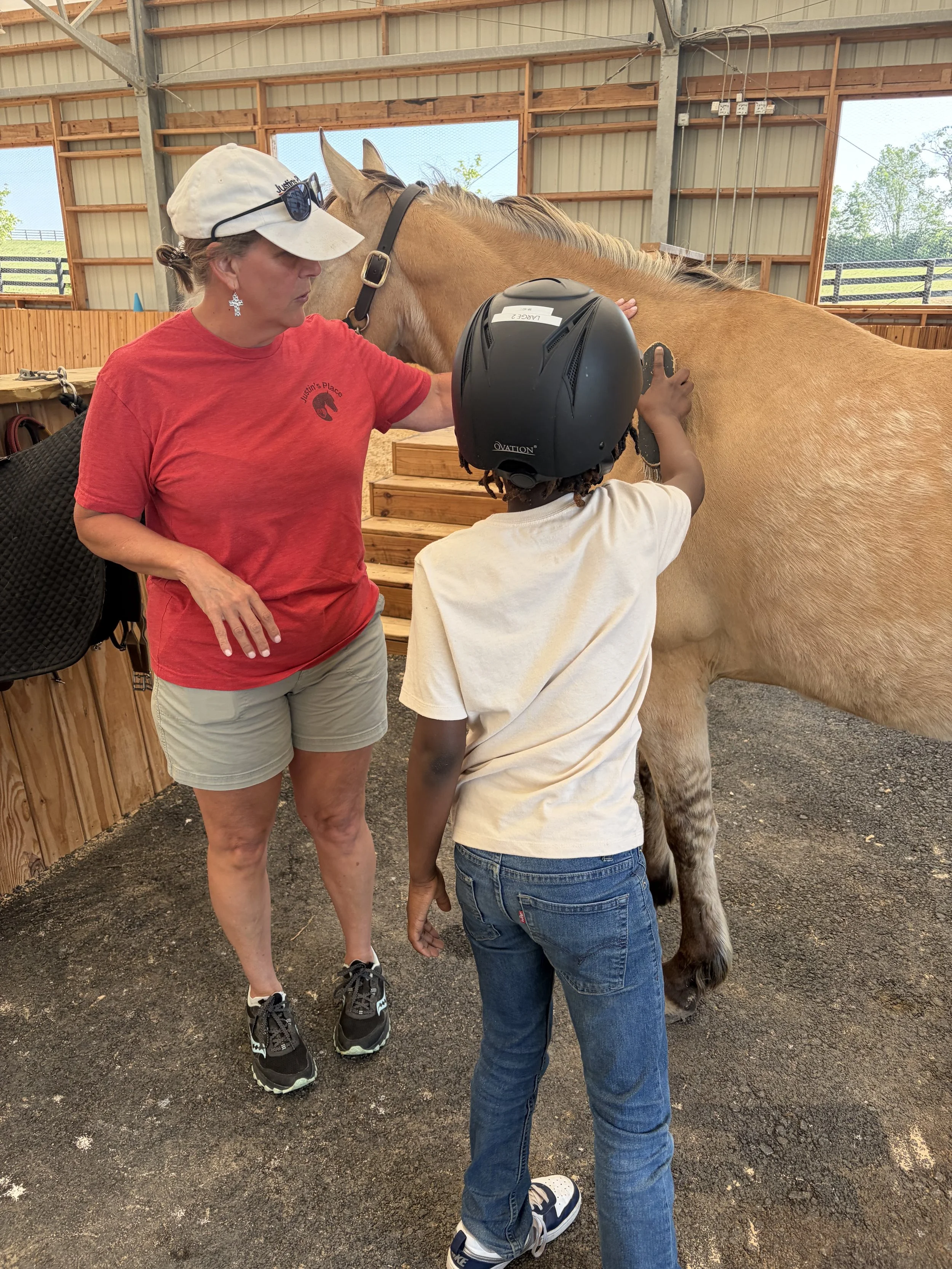
It can begin with a horse standing quietly beside a child.
It can happen while brushing, walking, riding, playing, or caring for an animal.
It can happen when an adult shows up again and again and does what they said they would do.
It can happen when a child makes a choice and realizes their voice matters.
It can happen when they try something difficult and discover they are capable.
And it can happen when a child begins to understand, perhaps little by little:
I am safe here.
I can trust this person.
My voice matters.
I belong.
Our Stable Moments Mobile program allows us to bring these experiences directly into schools and on our farm, particularly for children who may not otherwise have access to them.
For children in foster and adoptive care, these experiences can create opportunities to rebuild trust and experience relationships in a different way.
But restoration isn't only for children.
We believe caregivers need restoration, too.
Parenting a child who has experienced trauma can be exhausting. Caregivers are often carrying their own responsibilities, worries, and emotional weight while trying to remain steady for a child who may be struggling deeply.
Sometimes what a caregiver needs isn't another parenting strategy.
Sometimes they need a place to breathe.
A place to step out of problem-solving mode.
A place to reconnect with themselves.
A place where someone else understands that this is hard.
Our caregiver experiences and workshops are designed with that in mind. Through nature, animals, movement, education, conversation, and simple moments of respite, we want to create opportunities for caregivers to come back to the present moment.
To breathe.
To feel supported.
To remember that they are more than the challenges they are navigating.
Because restoration doesn't always mean returning to exactly what was before.
Sometimes what has been lost cannot simply be replaced.
Instead, restoration can mean creating something new—a new sense of safety, a new relationship, a new confidence, a new memory, or a new understanding of what connection can feel like.
At Justin's Place, we believe children and families deserve those opportunities.
Not because they need to be fixed.
But because they deserve experiences that help them rebuild, reconnect, and remember what it feels like to be safe, supported, and joyful.
Restoration is making space for what has been lost—and creating room for something beautiful to grow in its place.